OEM Tier1 Suppliers Manufacturing: The ERP Built for OEM and Tier-1 Suppliers
OEM Tier1 Suppliers Manufacturing demands ERP built for Indian factories. Supplying to OEMs means zero tolerance for delays, rejections, or documentation gaps. ERPDrive gives Tier-1 and Tier-2 auto component suppliers complete control over customer schedules, production planning, vendor management, quality compliance, and on-time delivery - all in one system.
OEM Tier1 Suppliers Manufacturing: The Unique Pressures of OEM Tier-1 Suppliers in India
Being a Tier-1 or Tier-2 supplier to automotive OEMs is one of the most demanding business models in Indian manufacturing. Your customers are large corporations with rigorous procurement processes, stringent quality requirements, and zero tolerance for supply disruptions. A missed delivery or a quality escape does not just cost you a penalty - it can cost you the entire contract.
OEM customers send weekly or bi-weekly delivery schedules that change frequently. They expect Just-In-Time deliveries that align with their production lines. They require PPAP submissions for every new part, IATF 16949 certified processes, and complete traceability from raw material to dispatch. On the commercial side, they operate on blanket orders with release-based deliveries, extended payment terms (60 to 90 days), and annual price reduction expectations.
Managing all of this on Tally and spreadsheets is not just inefficient - it is risky. One missed schedule revision, one incorrect delivery quantity, one quality document that cannot be located during an audit can have serious consequences. You need an ERP system that was built to handle the specific complexity of OEM supply chain operations.
ERPDrive was designed by working directly with Tier-1 and Tier-2 auto component suppliers. Every workflow - from customer schedule import to dispatch documentation - mirrors how OEM suppliers actually operate on a daily basis.
6 Challenges Every OEM Supplier Faces
These are the specific operational challenges that separate successful OEM suppliers from those that lose contracts. ERPDrive addresses each one with purpose-built features.
Customer PO and Schedule Management
OEMs do not place simple purchase orders. They issue blanket orders for annual quantities, then release weekly or daily delivery schedules against those blankets. Schedules change frequently - quantities shift between weeks, new part numbers get added, and delivery dates move. Tracking these changes manually is a full-time job that is prone to errors.
ERPDrive imports customer schedules and automatically creates or updates sales orders. The schedule comparison feature highlights what changed from the last version, so your planning team can focus on adjustments rather than manual data entry. Cumulative tracking against blanket orders ensures you never over-deliver or under-deliver.
- Blanket order management with cumulative delivery tracking
- Weekly schedule import and revision comparison
- Auto-conversion of schedules to production plans
- Multi-customer schedule consolidation for production planning
On-Time Delivery and JIT Compliance
OEM assembly lines cannot wait. If your delivery is late by even a few hours, it can halt the production line and trigger penalty clauses. Most OEMs track supplier delivery performance as a key rating metric, and poor ratings mean reduced business or contract termination.
ERPDrive provides a delivery adherence dashboard that shows every upcoming delivery with its status: on track, at risk, or delayed. The system proactively alerts your dispatch team when a shipment needs to be expedited. Dispatch planning considers packing time, transporter availability, and transit time to ensure the right quantity reaches the right plant at the right time.
- Real-time delivery adherence dashboard (green/amber/red)
- Proactive delay alerts to dispatch and production teams
- Transit time calculation for accurate dispatch planning
- Customer-specific delivery documentation and ASN generation
Vendor Management and Incoming Quality
As a Tier-1 supplier, you are only as good as your Tier-2 and Tier-3 vendors. Raw material quality directly impacts your finished product quality. Vendor delivery reliability affects your own delivery performance. Yet most suppliers manage their vendors with phone calls, WhatsApp groups, and spreadsheet-based tracking.
ERPDrive's vendor management module maintains a complete profile for each supplier: approved materials, rate contracts, quality history, delivery performance, and compliance documents. Incoming material inspection is mandatory before stock acceptance, with AQL-based sampling plans. Vendor ratings are calculated automatically and updated with every transaction.
- Automatic vendor rating across quality, delivery, price, and responsiveness
- Approved vendor list (AVL) management with material-level approval
- Incoming inspection with AQL sampling and rejection workflows
- Vendor compliance document tracking (test certificates, MSDS, etc.)
Sub-Contracting and Job Work Management
Most Tier-1 suppliers do not perform every process in-house. Heat treatment, plating, painting, and specialized machining are often sub-contracted to job workers. Managing material flow to and from multiple job workers, tracking processing status, handling returns with quality inspection, and managing GST job work challans is operationally complex.
ERPDrive manages the complete sub-contracting cycle. Issue materials with a DC or GST job work challan, track pending quantities at each job worker in real-time, receive processed goods with quality inspection, and reconcile scrap and rejections. The system ensures that input tax credit on job work is tracked correctly and that materials pending at job workers are visible in your inventory reports.
- Job work challan generation with GST compliance
- Real-time tracking of materials pending at each job worker
- Return processing with quality inspection and scrap reconciliation
- Job worker performance tracking and cost analysis
Quality Documentation and PPAP
Every new part, every engineering change, every material change requires PPAP submission to the OEM customer. This involves compiling 18 different document types: design records, process flow diagrams, control plans, MSA studies, capability studies, material test reports, dimensional results, and more. Most suppliers compile these manually in folders and email them to the customer.
ERPDrive's PPAP module guides you through the submission process for each part number. Documents are linked to the specific part and revision, so when the customer requests PPAP for a particular change, you can compile the complete package in minutes instead of days. All quality records from production (inspection results, SPC data, test certificates) are automatically linked and available for PPAP compilation.
- PPAP submission management for all 18 elements
- Part-level document linking with revision control
- Automatic compilation of quality records for submissions
- Customer approval tracking and resubmission management
Cash Flow and Working Capital Management
OEM payment cycles stretch to 60 to 90 days, while your raw material suppliers expect payment in 30 to 45 days. This creates constant working capital pressure. Add to that the cost of maintaining safety stock for JIT deliveries, work-in-progress inventory across multiple production stages, and finished goods buffer stock - and cash flow management becomes critical for survival.
ERPDrive provides real-time visibility into your receivables, payables, inventory value, and work-in-progress cost. The system helps you optimize inventory levels by calculating the right safety stock based on actual demand patterns and supplier lead times. Aging reports for both receivables and payables help you plan cash flow proactively.
- Real-time receivables and payables aging dashboards
- Inventory valuation across raw material, WIP, and finished goods
- Working capital optimization with safety stock calculations
- Cash flow forecasting based on order book and payment patterns
How ERPDrive Streamlines OEM Supplier Operations
ERPDrive connects every department in your organization into a single system - from sales order entry to dispatch, from purchase to payment, from production to quality. Here is how it transforms daily operations for OEM suppliers.
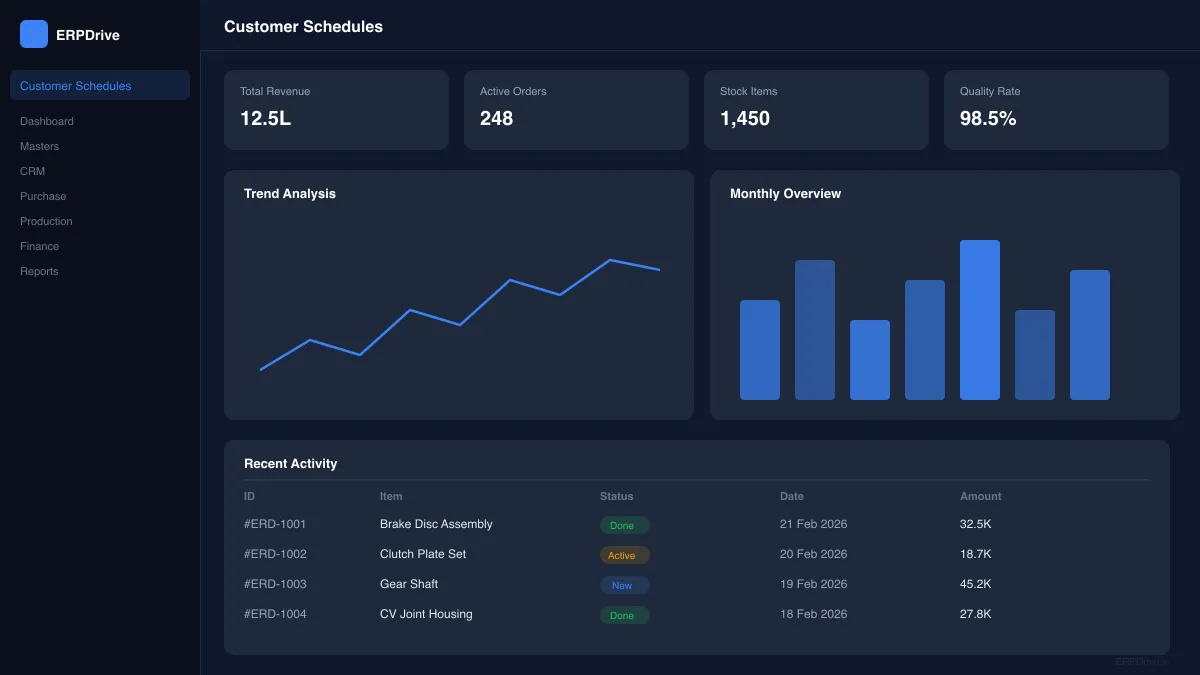
Unified Customer Schedule Dashboard
See all your OEM customer schedules in one place. The dashboard shows upcoming deliveries for the next 4 weeks with color-coded status indicators. Green means the delivery is on track with production complete or in progress and materials available. Amber means production is planned but materials are pending or capacity is tight. Red means the delivery is at risk and needs immediate attention.
When a customer revises their schedule, the system highlights every change: increased quantities, decreased quantities, new line items, and date shifts. Your planning team reviews the changes, confirms the updated plan, and the system automatically adjusts production orders, material requirements, and dispatch plans.
Integrated Vendor Ecosystem Management
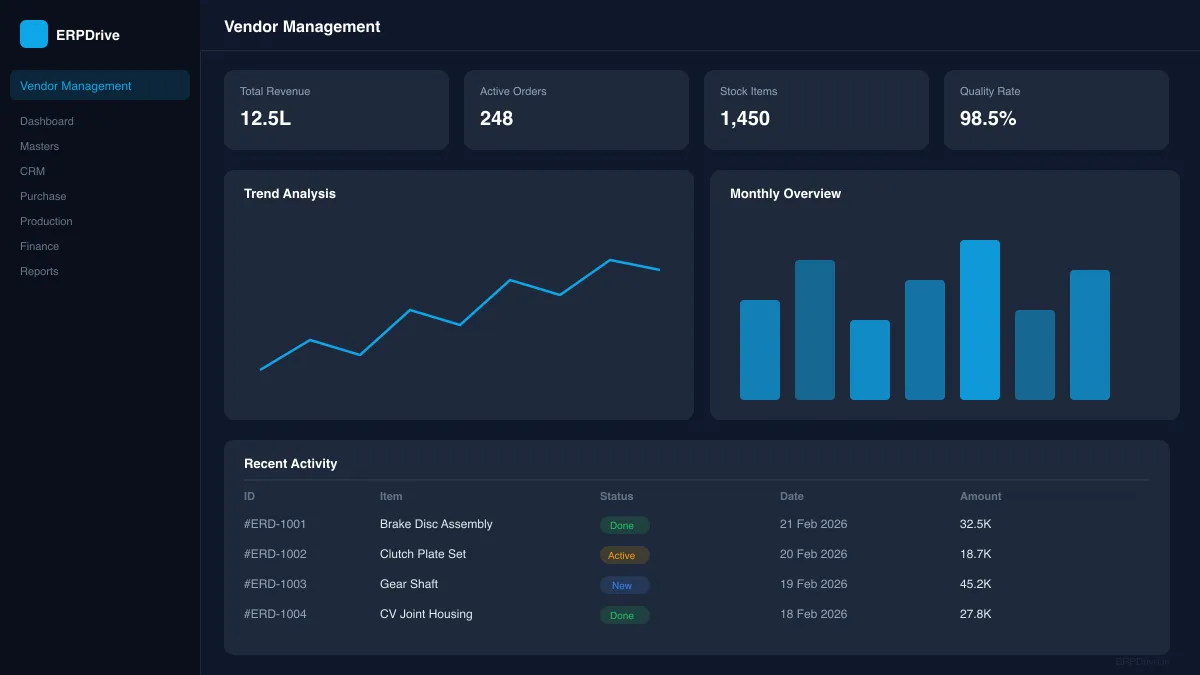
ERPDrive's vendor management goes beyond basic PO tracking. Every vendor has a 360-degree profile that includes their approved materials, rate contracts with validity periods, quality performance history, delivery track record, and compliance documents. When you raise a purchase requisition, the system automatically recommends the best vendor based on a composite score of quality, delivery, and price.
For critical materials, ERPDrive supports dual or multi-sourcing strategies. You can define primary and secondary vendors for each material, set split ratios for procurement, and ensure that you are never dependent on a single source. The vendor portal (optional) allows your suppliers to view POs, confirm delivery dates, and upload test certificates directly into the system.
Complete Sub-Contract and Job Work Tracking
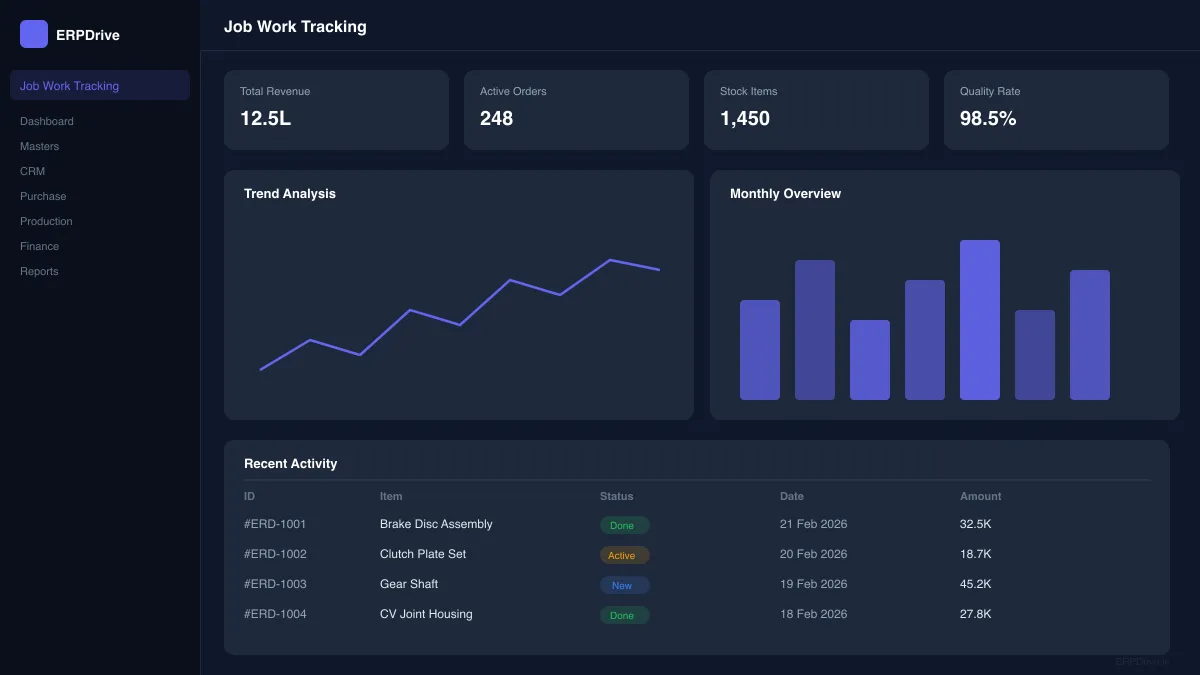
Issue materials to job workers with proper documentation (DC or GST job work challan). The system tracks exactly how much material is pending at each job worker, what has been processed, what is the expected return date, and what is the processing cost. When goods return from the job worker, mandatory quality inspection ensures that processing meets your specifications before the material moves to the next stage.
The job worker dashboard gives you a real-time view of all pending work across all job workers. You can see which job workers are overloaded, which are underutilized, and plan your sub-contracting accordingly. Scrap and rejection reconciliation ensures that material losses at job workers are tracked and accounted for.
PPAP and Quality Documentation Hub
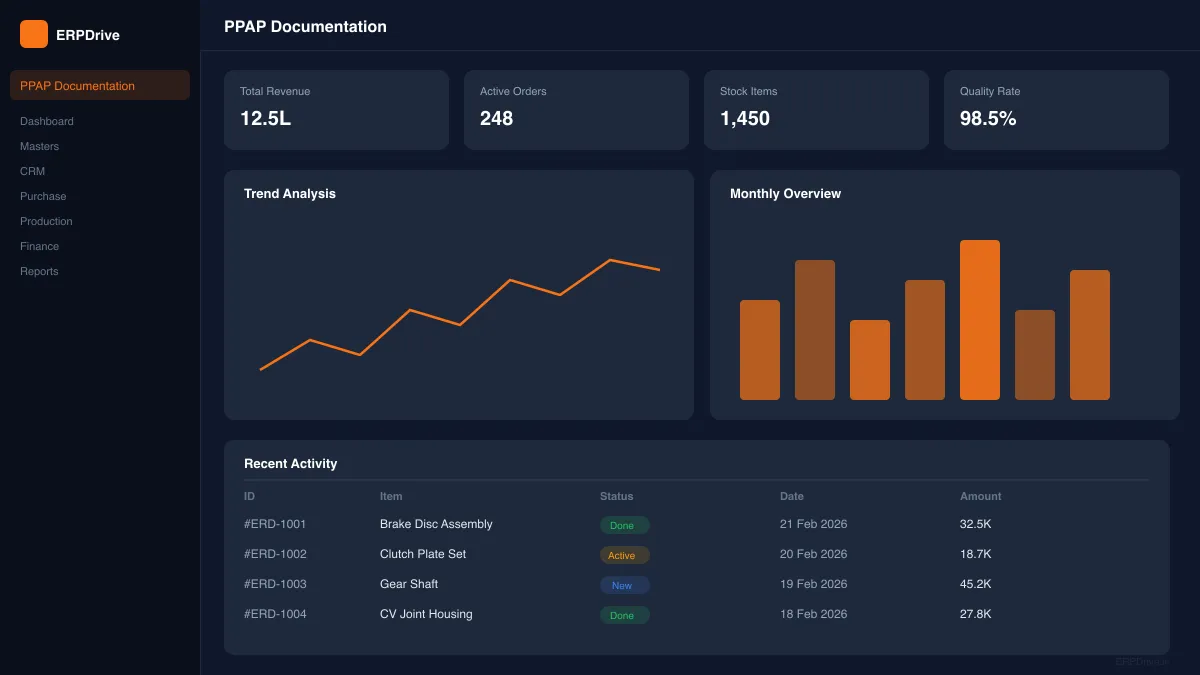
Every part number in ERPDrive has a dedicated quality documentation hub where all PPAP elements, inspection records, SPC data, and customer approvals are stored. When you need to compile a PPAP submission, select the part number and revision, and the system pulls together all available documents. You can see which elements are complete and which are pending, assign responsibility for incomplete items, and track the submission timeline.
For ongoing production, the quality module captures inspection data at every stage: incoming material, in-process at each work center, and final inspection. All this data feeds into the part's quality history, giving you and your OEM customer full traceability and confidence in the manufacturing process.
Meeting OEM Compliance Requirements
OEM customers audit their suppliers regularly. ERPDrive ensures you are always audit-ready with complete documentation and traceability.
Full Lot Traceability
Trace any finished part back to its raw material batch, supplier, inspection results, production operators, machine parameters, and quality records. Generate traceability reports in seconds during customer audits.
IATF 16949 Process Compliance
Quality workflows in ERPDrive are designed to meet IATF 16949 requirements. Control plans, FMEA linkage, process capability monitoring, and corrective action tracking are built into the production workflow.
GST and E-Invoicing
Generate GST-compliant invoices, e-way bills, and e-invoices from within ERPDrive. Job work challans follow GST rules for input tax credit. GSTR-1 and GSTR-3B reports are ready for one-click export.
Supplier Performance Reporting
Generate the delivery performance, quality PPM, and schedule adherence reports that OEM customers request during business reviews. Data is captured automatically through daily operations - no manual compilation needed.
Frequently Asked Questions
Common questions from OEM and Tier-1 auto component suppliers.
Tier-1 suppliers provide components directly to OEMs (vehicle manufacturers), while Tier-2 suppliers supply to Tier-1 companies. ERPDrive supports both tiers. For Tier-1 suppliers, the system handles direct OEM schedule imports, blanket order management, PPAP documentation, and JIT delivery tracking. For Tier-2 suppliers, it manages multiple Tier-1 customers, sub-contracting workflows, and the specific quality requirements each customer mandates.
Yes. ERPDrive supports importing delivery schedules from OEM portals. You can import schedules in Excel or CSV format, and the system automatically creates or updates sales orders, triggers MRP calculations, and generates production plans. Weekly schedule revisions from OEMs are handled through a schedule comparison feature that highlights changes from the previous version.
ERPDrive's blanket order module lets you record annual or quarterly contracts with OEM customers. As release orders come in, they are linked to the blanket order, and the system tracks cumulative quantities against the contract. You get real-time visibility into how much of the blanket order has been delivered, what is pending, and whether you are on track to meet the annual commitment.
Yes. ERPDrive automatically tracks supplier performance across four dimensions: quality (rejection rate from incoming inspection), delivery (on-time delivery percentage), price competitiveness (rate comparison across suppliers), and responsiveness. Each supplier gets a composite rating that is updated with every transaction. You can set minimum rating thresholds for approved supplier lists and generate supplier performance reports for management review.
Absolutely. Many Tier-1 suppliers sub-contract specific processes like heat treatment, plating, or specialized machining. ERPDrive manages the complete sub-contracting cycle: issue materials to the job worker with a DC or challan, track pending quantities at each job worker, receive processed goods with quality inspection, and reconcile scrap and rejections. GST job work challans are generated automatically with correct tax treatment.
Explore Other Industries
ERPDrive is trusted by manufacturers across diverse sectors.
Ready to Strengthen Your OEM Supply Chain?
Join Tier-1 and Tier-2 auto component suppliers across India who use ERPDrive to meet OEM demands with confidence. Book a free demo to see how ERPDrive handles your specific supplier workflow.
- Free 30-minute personalized demo
- See schedule management in action
- Understand vendor rating and PPAP workflows
- No commitment, no credit card