Precision Machining Manufacturing: Precision Machining ERP That Speaks Your Machine Shop's Language
Precision Machining Manufacturing demands ERP built for Indian factories. Precision machining is about microns, cycle times, and zero defects. ERPDrive is built for CNC job shops and precision machining units that need tight control over process routing, machine utilization, tool management, dimensional quality, and job costing - without the complexity of enterprise ERP systems.
Precision Machining Manufacturing: Precision Machining: Where Every Micron Counts and Every Minute Costs
India's precision machining industry serves automotive, aerospace, defense, medical devices, and industrial equipment sectors. Whether you run a CNC job shop with 5 machines or a precision manufacturing unit with 50 CNC turning and milling centers, your business depends on the same fundamentals: tight tolerances, consistent quality, maximum machine utilization, and accurate job costing.
The typical precision machining shop handles dozens of active jobs simultaneously, each with different materials, tolerances, process sequences, and delivery deadlines. A single CNC machine might process three different jobs in a shift, each requiring different tooling, fixtures, and programs. The shop floor is a constant juggling act of priorities, machine allocation, tool availability, and operator skill matching.
Most machine shops in India run on a combination of paper job cards, Excel spreadsheets, and the owner's memory. This works when you have 2 or 3 machines and a handful of customers. But as you grow - more machines, more jobs, more customers, tighter tolerances - the lack of a proper system becomes the bottleneck. Jobs get delayed because material was not ordered on time. Machines sit idle because the next job's tooling was not ready. Quality rejections eat into margins because dimensional data was not tracked properly.
ERPDrive was built by studying how precision machining shops actually work. The system handles everything from the quotation and process planning stage to production tracking, quality inspection, and dispatch - with features specifically designed for the machining industry.
6 Challenges Every Precision Machine Shop Faces
These operational challenges are specific to precision machining and CNC job shops. Generic ERP systems do not address them. ERPDrive does.
Process Routing and Operation Sequencing
A precision machined component typically goes through multiple operations: bar cutting, CNC turning (rough and finish), CNC milling, drilling, tapping, deburring, heat treatment, grinding, and surface finish. Each operation has specific machine requirements, tooling needs, setup times, and cycle times. The sequence matters - you cannot grind before heat treatment, and you cannot finish turn before rough turning.
Defining and managing these process routings for hundreds of different part numbers, each with its own sequence of operations, is critical for production planning and costing. Without a proper system, process knowledge lives in the heads of experienced operators and the shop owner, creating a dependency that limits growth.
- Multi-operation routing with machine and tooling specifications
- Setup time and cycle time tracking per operation
- Alternate routing management for capacity flexibility
- Operation-wise job card generation for shop floor tracking
Machine Utilization and OEE Tracking
CNC machines are your most expensive assets. A CNC turning center costs Rs 15 to 50 lakh, and a VMC or HMC costs Rs 30 lakh to Rs 2 crore. Every hour a machine sits idle is revenue lost. Yet most machine shops have no accurate data on actual machine utilization. They estimate it at 70 to 80 percent but have no way to verify or improve it.
Real machine utilization includes not just cutting time but also setup time, tool change time, program loading time, inspection time, and unplanned downtime (breakdowns, material shortage, operator absence). Understanding the breakdown of productive vs non-productive time is essential for improving OEE and identifying where the real bottlenecks are.
- Real-time machine status tracking (running, setup, idle, breakdown)
- OEE calculation: availability, performance, and quality metrics
- Downtime categorization and Pareto analysis
- Machine-wise production output and efficiency reports
Tool Management and Tool Life Tracking
Cutting tools are a significant cost in precision machining, typically 5 to 15 percent of the total machining cost. Carbide inserts, end mills, drills, reamers, and special form tools all have finite life. Running a tool beyond its life limit produces poor surface finish and out-of-tolerance parts. Changing tools too early wastes money.
Most machine shops track tool life informally - operators change tools based on experience or when they notice quality deteriorating. There is no systematic data on how many pieces each insert cuts, which materials wear tools faster, or which machines consume more tooling. Without this data, you cannot optimize tool procurement, predict tool costs for quotations, or establish reliable tool change intervals.
- Tool inventory management with crib location tracking
- Tool life tracking by pieces machined or cutting hours
- Tool change alerts and preventive replacement scheduling
- Tool cost per piece analysis for accurate job costing
Dimensional Quality Control and Inspection
Precision machining means tolerances of plus or minus 10 microns or tighter. Quality is not just a pass/fail check - it requires dimensional measurement of multiple critical characteristics, recording actual values, tracking trends, and calculating process capability. A customer drawing might have 15 to 30 dimensions to inspect, each with different tolerances.
Recording all these measurements on paper inspection sheets, then manually entering them into spreadsheets for analysis, is time-consuming and error-prone. When a customer asks for a dimensional report for a specific batch, finding and compiling the data takes hours. When you need to analyze rejection trends or process drift, the data is scattered across paper records and Excel files.
- Digital inspection sheets with characteristic-level measurement recording
- Automatic GR&R and process capability (Cpk) calculations
- SPC charts for critical dimensions with control limit alerts
- One-click dimensional inspection reports for customer submission
Scrap Analysis and Rejection Tracking
In precision machining, even a 2 to 3 percent scrap rate significantly impacts profitability, especially on high-value components. Scrap can occur due to tool wear, incorrect machine parameters, material defects, operator errors, or fixture issues. Without systematic scrap tracking and analysis, you cannot identify the root causes or take corrective action.
ERPDrive captures scrap data at each operation with reason codes. Over time, this builds a database that reveals patterns: which operations produce the most scrap, which machines have higher rejection rates, which materials are more problematic, and whether specific shifts or operators correlate with higher scrap. This data-driven approach to scrap reduction directly improves your bottom line.
- Operation-wise scrap recording with reason codes
- Scrap cost analysis by machine, operator, material, and part
- Pareto charts for top rejection reasons
- Corrective action tracking linked to scrap incidents
Accurate Job Costing and Quotation
Winning profitable work requires accurate quotations. Quoting too high loses the job to a competitor. Quoting too low wins the job but erodes your margin. The challenge is that most machine shops estimate costs based on gut feel or rough calculations rather than actual data from previous similar jobs.
Accurate job costing requires tracking the actual material consumed (including scrap), actual machine hours per operation (including setup), tooling cost, labor cost, sub-contracting cost (for processes like heat treatment or plating done outside), and overheads. When you have this data for completed jobs, you can quote new jobs with confidence and know exactly where your margin stands.
- Detailed quotation builder with operation-wise cost breakdown
- Actual vs estimated cost comparison after job completion
- Machine hour rate calculation with depreciation and overheads
- Historical cost database for similar parts and operations
How ERPDrive Transforms Your Machine Shop
ERPDrive connects every aspect of your precision machining operation into one system. From the moment a customer enquiry arrives to the final dispatch and invoicing, every step is tracked, measured, and optimized.
Visual Process Routing with Operation Job Cards
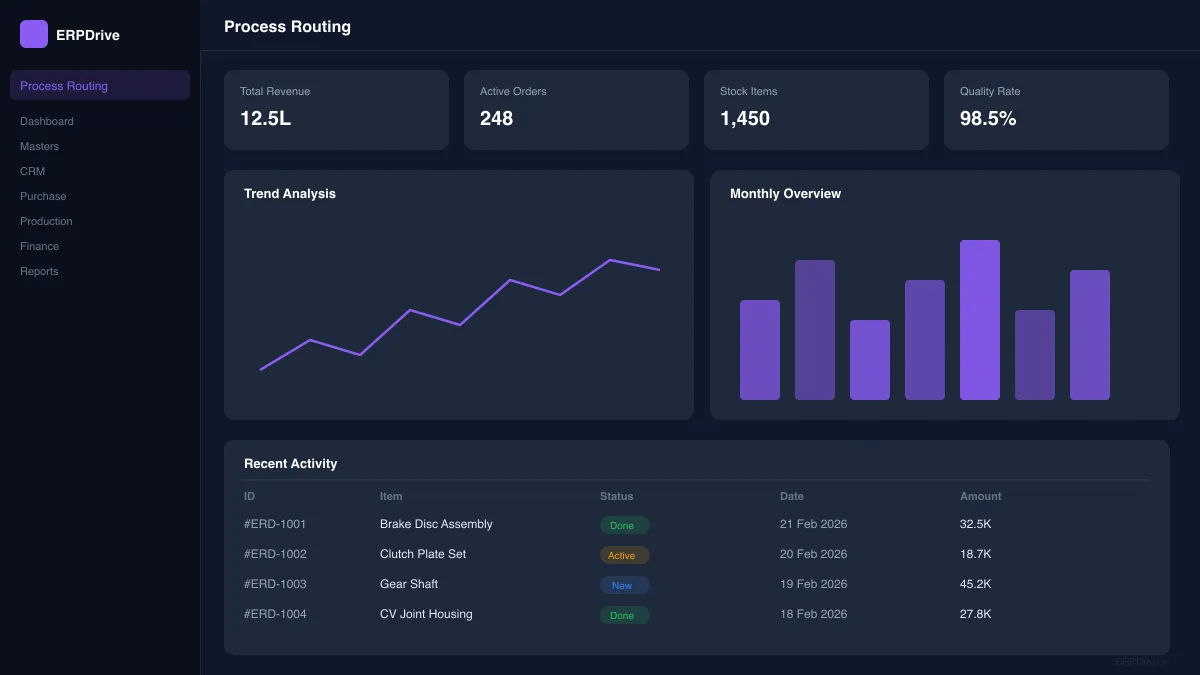
Define process routings for each part number with drag-and-drop simplicity. Each operation specifies the work center, machine type (CNC turning, VMC, grinding, etc.), fixture requirements, tooling list, CNC program reference, setup time, and standard cycle time. The visual routing diagram shows the complete process flow at a glance.
When a production order is released, ERPDrive generates individual job cards for each operation. Operators on the shop floor scan or select their job card, log start and end times, record pieces produced (good and rejected), and note any issues. This gives you real-time visibility into which operation each job is at, who is working on it, and whether it is ahead or behind schedule.
Real-Time Machine Dashboard and OEE Monitoring
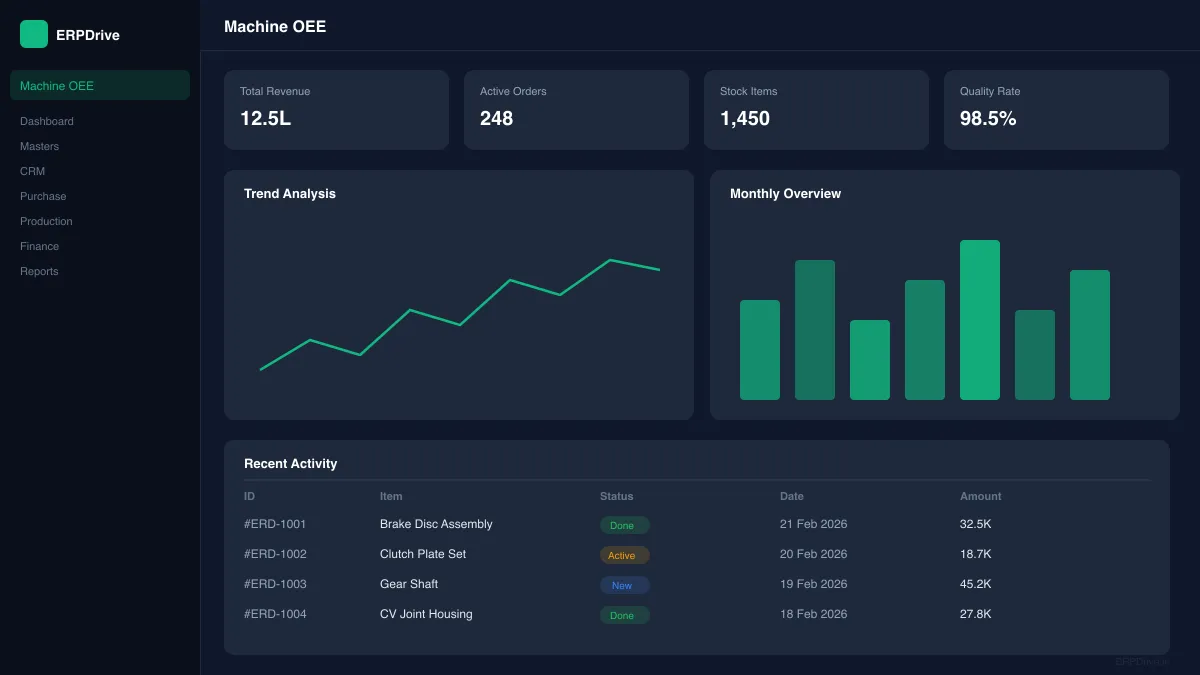
The machine dashboard shows every CNC machine in your shop with its current status: running (with the current job and operation), setting up, idle (with reason), or under maintenance. Color-coded indicators give the shop manager an instant overview of the entire floor without walking to each machine.
OEE metrics are calculated automatically from the data logged by operators. Availability accounts for planned production time minus downtime (breakdowns, no material, no operator). Performance compares actual output against theoretical capacity based on standard cycle time. Quality measures good parts against total parts. Each component is tracked separately so you know exactly what is dragging down your OEE and where to focus improvement efforts.
Comprehensive Tool Crib Management
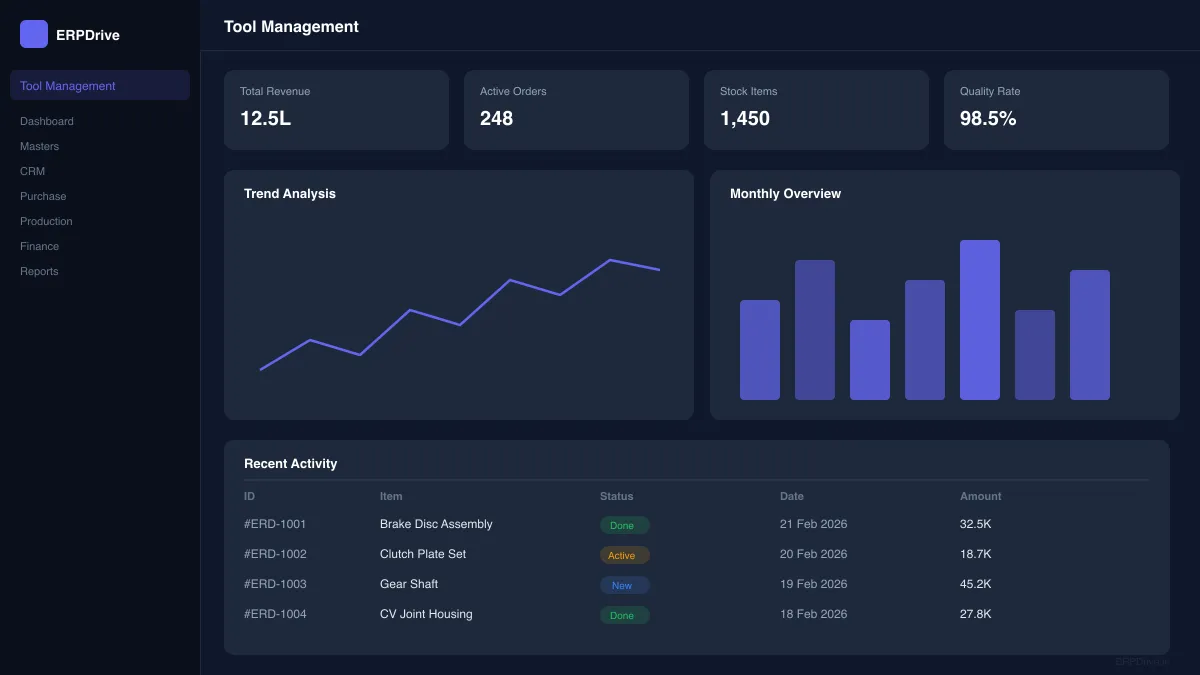
ERPDrive's tool management module maintains a complete inventory of all cutting tools, measuring instruments, fixtures, and jigs. Each tool has a defined life (in pieces or cutting hours), and the system tracks usage against this life with every production job card. When a tool reaches 80 percent of its life, an alert is triggered for the tool crib to prepare a replacement.
Tool issue and return are tracked per job card, so you know exactly which tools were used for which job and which machine. This enables accurate tool cost allocation to each job for costing purposes. The tool consumption report shows which tools are consumed most frequently and helps you negotiate better rates with tool suppliers or evaluate alternative tooling options.
Digital Dimensional Inspection and SPC
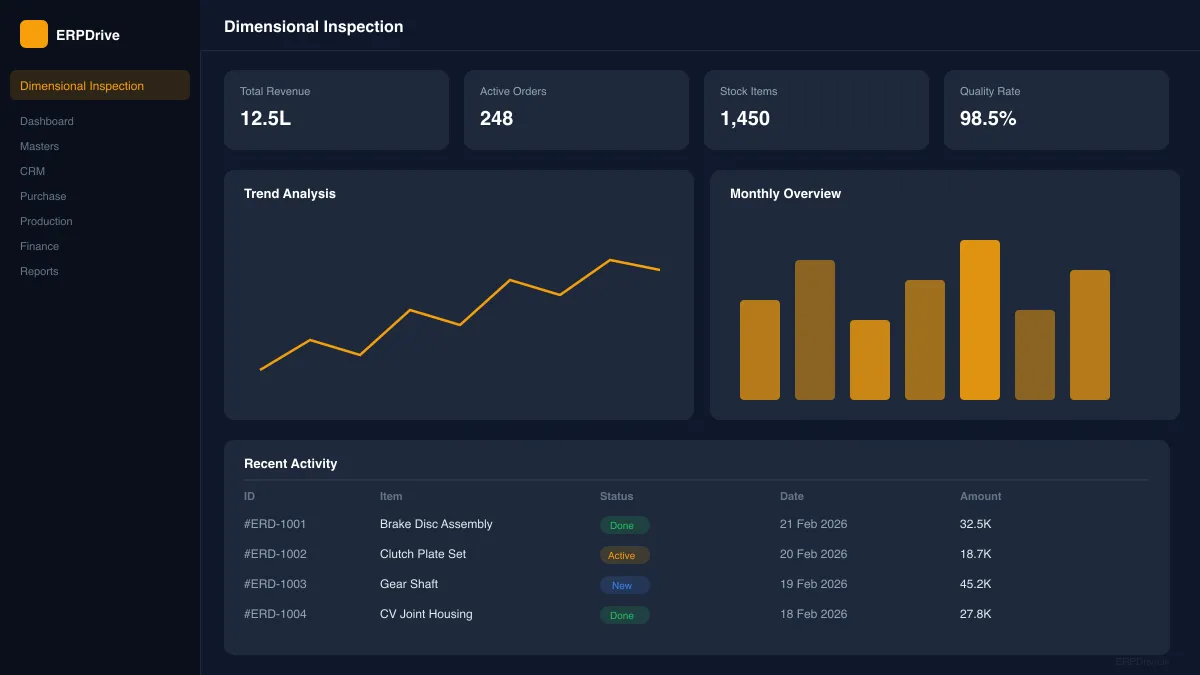
Create inspection plans for each part number with all critical dimensions from the customer drawing. Inspectors record actual measurements digitally - either manually or by importing data from CMM (Coordinate Measuring Machine) output files. The system automatically compares measured values against tolerances and flags out-of-specification dimensions.
For critical dimensions, SPC charts (X-bar R charts, individual moving range charts) are generated automatically. The system calculates Cp, Cpk, Pp, and Ppk values and alerts you when a process is drifting toward the specification limits before it actually produces a rejection. This proactive approach to quality significantly reduces scrap and customer complaints.
End-to-End Process Tracking for Every Job
From the moment raw material enters your shop to the final dispatch, ERPDrive tracks every step with precision.
Enquiry and Quotation
Receive customer enquiry, define process routing, calculate material, machining, and tooling costs. Generate a professional quotation with operation-wise cost breakdown. Track quotation follow-ups and conversion rates.
Sales Order and Material Planning
Convert accepted quotation to a sales order. MRP calculates material requirements and generates purchase requisitions for bar stock, castings, or forgings. Factor in material lead times to ensure availability before production starts.
Production Planning and Scheduling
Create production orders and schedule operations across CNC machines based on capacity, priority, and delivery dates. Generate operation-wise job cards for the shop floor. Balance load across machines to maximize utilization.
Shop Floor Execution and Tracking
Operators log job start, produce pieces, record scrap with reasons, and mark operations complete. Real-time dashboard shows production progress against the plan. Tool usage and machine hours are captured automatically.
Quality Inspection and Reporting
In-process and final inspection with dimensional measurement recording. SPC analysis for critical characteristics. Generate customer-ready inspection reports and test certificates with one click.
Dispatch and Invoicing
Create dispatch notes with packaging details, generate GST-compliant invoices with correct HSN codes, print e-way bills, and update delivery status. Job costing report shows actual vs estimated cost for the completed order.
Designed for Every Type of Machining Operation
ERPDrive supports the full range of precision machining processes used in Indian machine shops.
CNC Turning
Horizontal and vertical CNC lathes, Swiss-type turning, multi-spindle automats. Track cycle times, tool life, and bar utilization.
CNC Milling (VMC/HMC)
Vertical and horizontal machining centers, 3-axis, 4-axis, and 5-axis milling. Manage complex fixture setups and multi-part loading.
Cylindrical Grinding
External, internal, and centerless grinding. Track wheel dressing cycles, surface finish measurements, and roundness data.
Wire EDM and Spark EDM
Wire cut and die-sink EDM for complex profiles and hardened materials. Track wire consumption, electrode wear, and cycle times.
Gear Cutting
Hobbing, shaping, and gear grinding. Manage hob life tracking, gear inspection (profile, lead, pitch, runout), and setup parameters.
Surface and Form Grinding
Surface grinding, jig grinding, and form grinding. Track flatness, parallelism, and surface roughness measurements across batches.
Frequently Asked Questions
Common questions from precision machining shops and CNC job shops.
Yes. ERPDrive allows you to define detailed process routings for each part. Each operation in the routing specifies the work center or machine, setup time, cycle time per piece, tooling requirements, and quality inspection points. When a production order is created, the system generates operation-wise job cards that can be tracked on the shop floor. Operators log start and end times for each operation, giving you real-time visibility into production progress.
ERPDrive calculates machine utilization based on planned vs actual production hours logged against each machine. The system tracks three components of OEE: availability (uptime vs planned production time, accounting for breakdowns and changeovers), performance (actual cycle time vs standard cycle time), and quality (good parts vs total parts produced). OEE dashboards give you a real-time view of each machine's efficiency and highlight where improvements are needed.
Yes. ERPDrive's tool management module tracks each cutting tool's life in terms of number of pieces machined or cutting hours used. When a tool approaches its life limit, the system alerts the operator and the tool crib. Tool change history is recorded against each machine and each production order, so you can analyze tool consumption patterns, identify tools that wear faster than expected, and optimize tool procurement.
ERPDrive provides detailed job costing that compares estimated cost (from the quotation stage) with actual cost (captured during production). Costs are broken down into material cost, machine cost (based on actual hours and machine hour rates), labor cost, tooling cost, sub-contracting cost, and overheads. After each job is completed, you can see exactly where costs deviated from estimates and use this data to improve future quotations.
Absolutely. ERPDrive is designed to be practical for small and mid-sized machine shops. You do not need an IT team to set up or maintain the system. The interface is simple enough for shop floor operators to use, and contact us for a tailored plan that fits your factory. Many of our customers are job shops with 5 to 15 CNC machines that previously managed everything on spreadsheets or paper-based systems.
Explore Other Industries
ERPDrive is trusted by manufacturers across diverse sectors.
Ready to Run Your Machine Shop Smarter?
Join precision machining companies across India that use ERPDrive to maximize machine utilization, reduce scrap, and deliver on time. Book a free demo tailored to your shop floor.
- Free 30-minute personalized demo
- See process routing and OEE tracking in action
- Get a custom implementation plan for your shop
- No commitment, no credit card