ERP Software for FMCG and Consumer Products Manufacturers
Batch-numbered production, multi-level BOMs, GRN with QC inspection, batch-wise stock across warehouses, GST e-invoicing and distributor credit control: one cloud ERP for Indian consumer goods manufacturers moving off Tally and Excel.
Why Tally plus Excel breaks down for consumer products
Incense sticks, personal care, home care, packaged non-food goods: these businesses make hundreds of batches a month across dozens of SKUs, and sell through distributors who buy on credit. Tally records the accounting after the fact. Excel holds the stock sheet somebody updates at night. Neither can answer the questions that actually run the factory:
Batch traceability lives in registers
A distributor reports a quality issue on one carton. Which production batch was it? Which raw material lots went into that batch, and from which supplier GRN? If the answer is buried in paper registers and three Excel sheets, a one-carton complaint becomes a full-day investigation.
No live view of production
Work orders are verbal or on paper. Nobody in the office knows which batches are at mixing, which at filling, which at packing. Sales commits dispatch dates on guesswork, and the answer to "when will 500 cartons be ready" is always "let me check with the floor".
Dispatch chaos across godowns
Finished goods sit in the factory store plus one or two rented godowns. Orders get matched to stock manually, the wrong batch ships, and stock registers at each location disagree with each other and with Tally by month end.
GST work done twice
The invoice is made in one system, then the same data is re-typed into the e-invoice portal for an IRN, then again into the e-way bill portal. Every re-entry is a chance for a mismatch that surfaces later as a notice or a blocked vehicle.
Credit given blind
Distributors order on phone and WhatsApp. Goods leave before anyone checks the outstanding. By the time Tally shows a party 90 days overdue, three more dispatches have gone out to them.
Three versions of the truth
Production has its notebook, stores has its Excel, accounts has Tally. Reconciling them consumes the first week of every month, and the owner still cannot say with confidence what any batch cost to make.
How ERPDrive runs a consumer products factory
Here is the flow we will walk through in a 30-minute demo, using your own products rather than generic sample data:
- Items and multi-level BOMs
A finished SKU (say a 100 g pack) has a BOM containing an intermediate item: the bulk mix, blend, or base product, which carries its own BOM of raw materials. Packing materials (pouches, cartons, labels, tapes) sit at the finished-goods level. Change a raw material price and the cost rolls up through every level.
- Procurement with GRN and QC inspection
Purchase orders go to suppliers with agreed rates. Material arrives against a GRN, QC inspects and accepts or rejects, and only accepted quantity enters stock: batch-tagged, so you always know which supplier lot is sitting in which store.
- Work orders with batch numbering
A production run is a work order that generates a batch number. The batch number follows the product from raw material issue through every stage to the finished carton. Batch-wise production is the backbone of traceability, costing, and recall readiness.
- Job cards on the shop floor
Each stage (mixing, forming, filling, packing: whatever your process looks like) gets a job card. Supervisors book completed quantities and material consumption against the BOM, so the office sees stage-wise progress without walking the floor.
- Batch stock movements across warehouses
Every movement (raw material store to production, production to finished goods, factory to godown) is a batch-wise stock transaction. Stock reports show quantity by item, by batch, by warehouse, in real time, and they agree with accounts because they are one system.
- Finished goods dispatch
Orders are picked batch-wise from the right warehouse, a dispatch note is created, and the invoice follows from the same data. No more shipping from one godown while the stock sheet says the goods are in another.
- E-invoice and e-way bill from the invoice screen
IRN and QR code generated on the invoice; e-way bill created for dispatches that need one. Zero re-typing into government portals, zero mismatch between what you billed and what you reported.
- Distributor credit control and WhatsApp updates
Each distributor carries a credit limit and payment terms. Outstanding shows against the limit at order and dispatch stage; over-limit parties need an approval before goods move. WhatsApp notifications go out on order confirmation and payment receipt, so parties stop calling to ask.
What you get out of the box
These are standard ERPDrive modules, configured for consumer products in the first week. No custom development:
Batch-wise production and traceability
Batch numbering on every work order; trace any batch back to supplier GRNs and forward to invoices.
Multi-level BOM
Finished SKU, intermediate mix or blend, raw and packing materials: costs roll up through every level.
Work orders and job cards
Stage-wise job cards with quantity and consumption booking; live WIP visibility from the office.
Procurement, GRN and QC
PO to GRN to inspection; only accepted material enters batch-tagged stock.
Multi-warehouse batch inventory
Batch stock movements across factory stores and godowns; one stock truth that matches accounts.
Finished goods dispatch
Batch-wise picking, dispatch notes, and invoicing from the same order data.
GST e-invoicing and e-way bills
IRN, QR code, and EWB generated from the invoice, not re-typed into portals.
Distributor and credit management
Credit limits, payment terms, outstanding visibility at order and dispatch stage.
Finance and accounting
Sales, purchases, receipts, payments, and ledgers in the same system as production and stock.
WhatsApp notifications
Order and payment notifications reach distributors and customers automatically.
GST handled where the work happens
For a consumer products unit dispatching daily to distributors across states, GST is not a month-end activity. ERPDrive builds it into the transaction:
Who runs on ERPDrive
500+ manufacturers across India trust ERPDrive, and consumer products makers are already among them: incense (agarbatti) manufacturers run their production, batch tracking, dispatch, and accounts on dedicated ERPDrive editions today. The same batch-first production model fits personal care, home care, and packaged non-food goods, because the operational problem is identical: many small batches, many SKUs, distributor sales on credit, and GST paperwork on every dispatch.
If your unit makes food products with mandatory expiry and FSSAI requirements, start with our food processing page instead. If you also manufacture your own packaging, see the packaging manufacturing page.
Pricing
Frequently asked questions
How does batch traceability work in ERPDrive?
Every production run gets a batch number. Raw materials are batch-tagged at GRN, consumption is booked against the production batch, and every stock movement to finished goods and dispatch carries the batch. From a single batch number you can trace back to the supplier GRNs and forward to the invoices it was dispatched on.
Can ERPDrive handle multi-level BOMs with intermediate mixes and blends?
Yes. A finished SKU can have a BOM that includes an intermediate item (a mix, blend, or bulk product) which has its own BOM of raw materials. Packing materials sit at the finished-goods level. Work orders can be raised at any level, and consumption rolls up correctly.
Does ERPDrive generate GST e-invoices and e-way bills?
Yes. E-invoices with IRN and QR code are generated from the sales invoice screen, and e-way bills are created for dispatches that need them. No re-typing invoice data into government portals.
How does distributor credit control work?
Each distributor or customer carries a credit limit and payment terms. Outstanding is visible against the limit at order and dispatch stage, so goods do not leave the factory for a party who is already over limit without an approval. WhatsApp notifications keep parties informed on orders and payments.
Does ERPDrive support expiry-date management, FSSAI documentation, retail POS, or van sales?
Batch numbering and traceability are standard. Expiry-date management, FSSAI-specific documentation, retail POS, and van-sales DMS are not part of the standard offering today. If your business needs any of these, talk to us about your requirement and we will tell you honestly what fits and what does not.
How long does it take to move from Tally and Excel to ERPDrive?
Most small consumer products units go live in 1 to 2 weeks. We import your item master, BOMs, party ledgers, and opening stock, then run your first production batches and dispatches in parallel with your old process until you are confident.
The exact menus your factory team will use
This is the real ERPDrive navigation for a consumer products manufacturer: production to dispatch to GST in one system.
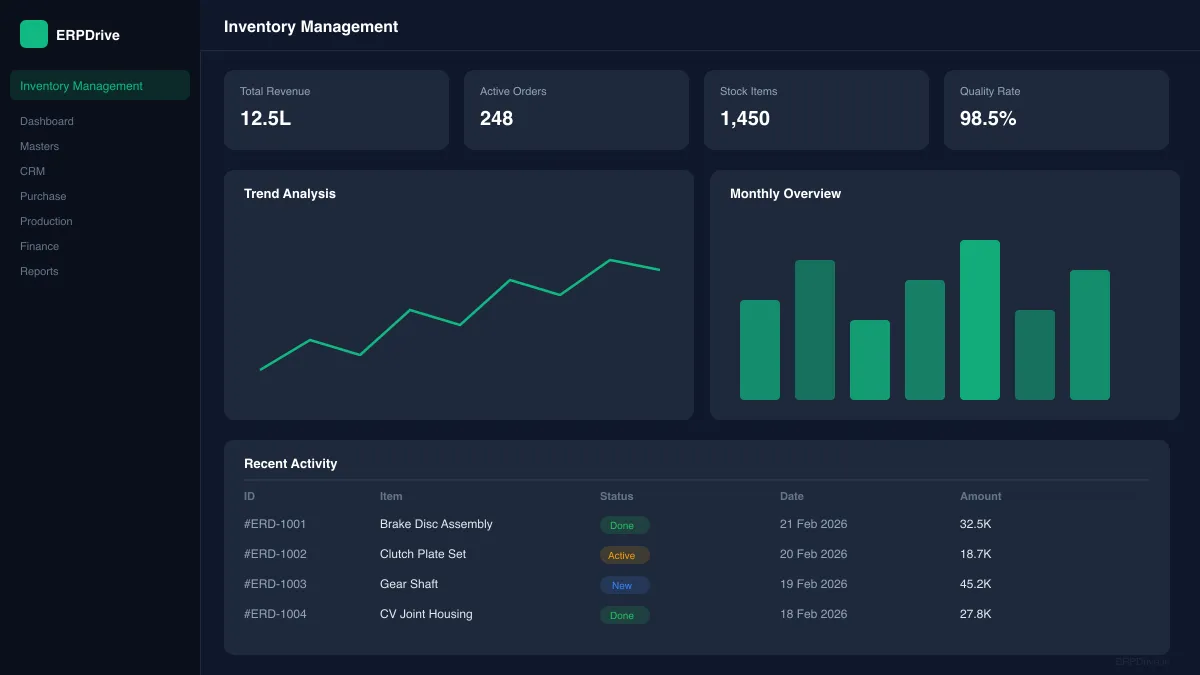
Actual navigation from ERPDrive Cloud. Book a demo to click through it live.
See ERPDrive on your products, not sample data
Free 30-minute demo built around your SKUs, your BOMs, and your dispatch flow. Scheduled within 24 hours. Or chat with us on WhatsApp.