ERP Software for Dyeing and Printing Process Houses
Grey fabric inward to shade-approved dispatch on one system: dye recipes and batch cards, your own process stages, Delta E shade approval, design-to-machine scheduling, WhatsApp order tracking for your customers, and automatic proforma billing with rate cards. Built for job-work process houses in clusters like Surat, Tirupur, and Ahmedabad.
The problems a challan register cannot solve
A process house is a job-work business: the fabric belongs to your customer, the value you add is shade, print, and finish, and your margin lives or dies on machine utilisation and rework. Accounting software sees none of that. These are the failures we hear from process house owners every week:
Shade rejections found after delivery
Shade is approved by eye against a swatch, under whatever light is available on the floor. A lot that looked fine leaves the house, the trader's buyer rejects it, and now you are paying for re-dyeing: dyes, chemicals, steam, machine hours, and a customer who trusts you a little less.
Lot mixups between customers
Dozens of traders send grey fabric, and hundreds of lots sit on the floor at any time. When identification lives on a slip tied to a bale, lots get dyed against the wrong program, printed with the wrong design, or billed to the wrong party. Sorting it out costs days and goodwill.
Billing from the challan register
Grey inward goes into a register, processing happens over weeks, and billing happens at month end from memory plus registers. Lots get missed and never billed. Rates get disputed because nobody can produce the agreed rate for that quality. Collections drag because invoices go out late.
Machines idle while orders wait
Planning happens on a whiteboard or in the master's head. Nobody can see which machine can take which fabric width, so a jet sits idle while a lot that fits it queues behind the wrong machine. Every idle machine-hour in a process house is margin you never get back.
The status-call treadmill
Traders call all day asking where their lot is. Your office staff walk the floor or flip registers to answer, and the answer is stale by evening. There is no way for a customer to see for themselves that their lot is at printing and will finish this week.
ETP records in a paper register
Effluent treatment is a licence-to-operate issue for every wet processing unit. When ETP readings live in a paper register, gaps show up exactly when an inspection happens, and reconstructing months of records is stressful and unconvincing.
How a lot flows through ERPDrive, inward to invoice
This is the exact flow we demonstrate, and the same flow running daily at a live process house. Each step closes one of the failures above:
- Grey fabric inward with multi-fabric receipts
One inward receipt can carry several fabrics from the same customer challan, each with its own quality, quantity, and panna. Fabric names are free entry, so any quality a trader sends is recorded as-is, tagged to that customer, and traceable from the first minute. No more slip-on-a-bale identification.
- Dye recipes and batch cards
Recipes are stored per shade and quality. When a batch is created, the batch card carries the recipe, the customer, the grey lot it consumes, and the target shade. The dye master works from the card, not from memory, so a repeat order gets the same recipe as the last approved lot.
- Your stages, your board
The process-stage master is editable: define the stages your house actually runs, in your order, with your names. Those stages become the batch card steps, the production board columns, and the tracker your customers see. When your process changes, you edit the master; the software follows.
- Shade approval gated on Delta E
Each shade in the shade library carries a standard and a Delta E tolerance. At the approval stage the measured Delta E is recorded against the standard, and the batch clears the gate only within tolerance. Rejections surface at the machine, when a re-dye is cheap, not at the trader's godown, when it is expensive.
- Screen printing and design management
Designs are managed alongside orders, so the printing team knows exactly which design runs on which lot. No more printing the right fabric with the wrong design because two traders sent similar qualities in the same week.
- Design-to-machine scheduling by panna and throughput
Every machine is defined by the panna it can take (in inches) and its throughput. The scheduler matches waiting orders to machines that can actually run them, so wide-width lots stop queueing behind narrow machines and idle capacity becomes visible instead of invisible.
- Customer tracking: WhatsApp updates plus a public link
Every customer order gets a public tracking link, no login needed, showing the current stage. WhatsApp notifications go out as the lot moves. Traders check their phone instead of calling your office, and your staff get their day back.
- Completion to invoice, automatically
When a batch is marked completed, a draft proforma invoice is created from that customer's rate card. Monthly volume discount schemes on grey inward apply the agreed slab without anyone doing month-end arithmetic. You review, confirm, and raise the GST invoice. Nothing completed goes unbilled.
What the Process House Edition includes
Every feature below is built and in daily use at a running process house. Nothing here is a roadmap item:
Grey fabric inward receipts
Multi-fabric receipts against customer challans; free-entry fabric names; customer-wise lot traceability from day one.
Dye recipes and batch cards
Recipes per shade and quality; batch cards carry recipe, customer, grey lot, and target shade.
Editable process-stage master
Your stages, your sequence, your names; drives batch steps, board columns, and the customer tracker.
Shade library with Delta E gate
Standard plus tolerance per shade; batch approval gated on measured Delta E against the standard.
Screen printing and design management
Designs tied to orders so the right design runs on the right lot, every time.
Design-to-machine scheduling
Machine capacity by panna (inches) and throughput; orders matched to machines that can run them.
Customer order tracking
WhatsApp notifications on stage changes plus a public tracking link per order, no login needed.
Automatic proforma on completion
Batch completion creates a draft proforma invoice; review and convert, so no lot is missed at billing.
Per-customer rate cards
Agreed rates per customer and quality applied automatically; rate disputes end because the rate is on record.
Monthly volume discount schemes
Slab-based discounts on monthly grey inward volume, computed by the system, not by month-end arithmetic.
ETP tracking
Effluent treatment records maintained in the system, ready when the pollution control board asks.
GST invoicing
GST-compliant invoices for job-work processing, raised from the confirmed proforma.
Why a dedicated deployment matters for a process house
ERPDrive Process House Edition runs as a dedicated deployment: your own instance, your own database. For a job-work business, that separation is not a luxury:
Pricing
Frequently asked questions
Can I define my own process stages for dye batches?
Yes. The process-stage master is fully editable. Whatever stages your house actually runs (for example grey inspection, scouring, dyeing, shade approval, printing, finishing, folding, dispatch) become the batch card steps, the board columns, and the customer-facing tracker. Add, rename, or reorder stages any time; no custom development needed.
How does shade approval with Delta E work?
You maintain a shade library with a standard and a Delta E tolerance for each shade. At the shade-approval stage the measured Delta E against the standard is recorded, and the batch clears the gate only within tolerance. Out-of-tolerance readings are flagged before the lot moves ahead, so re-dye decisions happen inside the machine cycle instead of after delivery.
Can my customers track their own lots?
Yes. Each customer order gets a public tracking link that shows the current stage of the lot, with no login required. WhatsApp notifications go out as the order moves through stages. Traders stop calling your office for status, and your despatch clerk stops flipping through registers to answer them.
How does billing work for job-work processing?
When a dye batch is marked completed, a draft proforma invoice is created automatically using that customer's rate card. Monthly volume discount schemes on grey inward apply the agreed slab automatically. You review the draft and convert it to a GST invoice. No lot is billed twice and no completed lot goes unbilled.
We process many fabric qualities and pannas. Can the system handle that?
Yes. Fabric names are free entry, so you can record any quality your customers send without waiting for a master to be configured. Panna is entered in inches. Machine capacity is defined by panna and throughput, so the scheduler only proposes machines that can actually run the fabric.
Is ERPDrive Process House Edition a shared cloud product?
No. The Process House Edition runs as a dedicated deployment: your own instance and your own database, separate from other companies. Your recipes, rate cards, and customer data stay in an environment that is yours alone. Every feature on this page is already built and in daily use at a running process house.
The exact menus your process house will run on
This is the real Dye House navigation from ERPDrive: every lot, batch and bill lives in these screens.
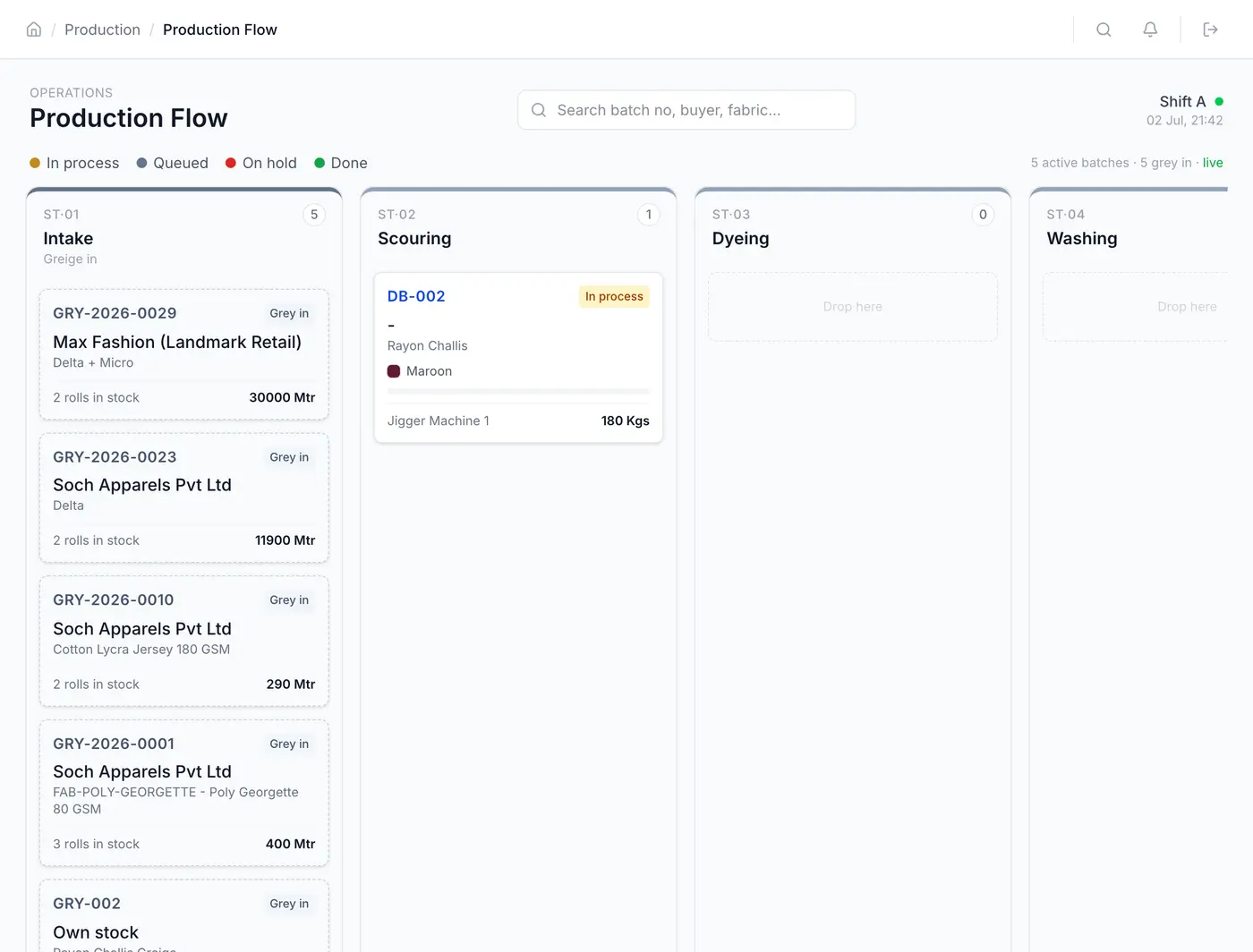
Actual navigation from the ERPDrive Process House Edition. Book a demo to click through it live.
See ERPDrive on your own lots and shades
Free 30-minute personalised demo using your fabrics, your stages, and your rate structure. Scheduled within 24 hours.